
Introduction: The New Era of Digital Synthesis
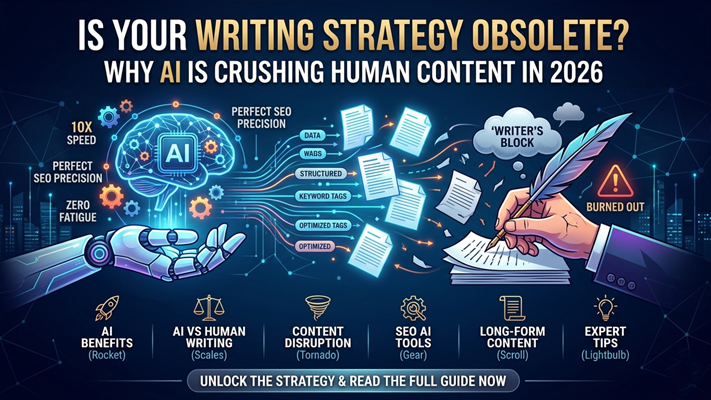
The world of writing is no longer confined to the speed of a human keyboard. We have entered an era of “Algorithmic Synthesis,” where Artificial Intelligence (AI) acts as both the library and the architect. By analyzing billions of linguistic patterns, AI doesn’t just “predict” words—it constructs logical, persuasive, and highly informative narratives. This shift represents a move away from manual labor toward strategic curation, where the goal is to produce the highest quality information in the shortest possible time.
The Benefits: Why AI Surpasses Manual Writing
The advantages of AI integration are not just incremental; they are exponential. When comparing AI to traditional human drafting, several key pillars of superiority emerge:
- Unmatched Scalability: A human team might struggle to produce five high-quality articles a week. An AI system can generate fifty in a single afternoon, allowing for massive “Content Moats” that protect and grow your online presence.
- Synthesized Intelligence: Humans are prone to “siloed” thinking based on their specific education. AI, however, draws from cross-disciplinary data—linking economics, psychology, and technology in a single paragraph to provide a more holistic view.
- Mathematical SEO Precision: AI understands the $TF-IDF$ (Term Frequency-Inverse Document Frequency) balance that search engines look for. It ensures that your article isn’t just readable for humans, but perfectly “crawlable” for search bots.
- Global Accessibility: Within seconds, a single English draft can be localized into Spanish, Mandarin, Arabic, or Urdu, retaining the original intent while respecting cultural linguistic nuances.
Related Tools
Painful Pointing: Overcoming the Human Bottleneck
Traditional writing is fraught with “friction points” that slow down business growth and creative output:
- The Research Wall: Most writers spend 70% of their time reading and only 30% writing. AI flips this ratio, providing instant summaries of complex data so the focus stays on the message.
- Emotional Variability: Human output is affected by sleep, stress, and interest level. AI provides a “Gold Standard” of quality that remains 100% consistent regardless of the volume of work.
- The Revision Trap: Manual drafts often require three or four rounds of back-and-forth editing between a writer and a manager. AI tools allow for “Instant Iteration,” where a tone shift or a factual correction happens in real-time.
The Strategic Choice: Why I Am Using This Tool
The adoption of this technology is a commitment to Efficiency over Effort. I use this tool to:
- Bridge the gap between a raw idea and a polished professional publication.
- Eliminate the overhead costs associated with traditional content agencies.
- Ensure that every piece of content published is backed by data-driven insights and perfect grammatical structure.
The Disruption: Reshaping the Creative Economy
We are witnessing a total disruption of the “Gig Economy.” Simple copywriting is becoming an automated utility, similar to electricity or water. This forces human creators to level up, moving from “writers” to “AI Strategists.” The disruption isn’t about replacing people; it’s about removing the mundane tasks of drafting and proofreading so humans can focus on high-level innovation and unique storytelling.
Core Features: The Engine Under the Hood
What sets high-level AI writing apart are the features that mimic deep cognition:
- Semantic Understanding: The ability to differentiate between “Apple” the fruit and “Apple” the tech company based on the surrounding context.
- Tone Modulation: The capability to shift from a rigid, academic whitepaper to a viral, “click-worthy” social media thread instantly.
- Structural Logic: Automatically generating Table of Contents, H-tags, and internal summaries to improve user experience (UX).
How to Use This Tool: The Master Workflow
To unlock the “Longest Detail” mode, you must master the art of the Nested Prompt:
- Define the World: Give the AI a specific background. Tell it the target audience’s pain points and goals.
- Request an Expanded Outline: Never ask for the full article at once. Ask for a 10-point outline first to ensure the logic is sound.
- Command Depth: Use phrases like “provide a detailed historical context” or “include a technical breakdown of the benefits” for each section.
- Final Polish: Use the AI to “Check for flow” and “Ensure active voice” across the entire document.
Tips for Content Excellence
- Iterative Deepening: If a section feels too short, highlight it and ask the AI to “Expand this specific point with a case study.”
- Formatting for Scannability: Use bolding for key terms and bullet points for lists. This keeps the reader engaged in long-form content.
- The “Human Hook”: Always add a unique intro or a personal anecdote to the AI’s draft to make it feel authentic and grounded.
FAQ: Common Concerns Addressed
Does AI content get flagged by search engines?
Google’s primary concern is “Information Gain.” If your AI content provides new value, better formatting, or clearer answers than existing pages, it will be rewarded, not penalized.
Can AI handle technical or scientific writing?
Yes. In fact, AI is often better at technical writing because it can maintain precise terminology and complex formulas (like $E=mc^2$ or $A = \pi r^2$) without the risk of “typos” that a human might make.
Is my data safe with AI writing tools?
Most professional-grade AI tools have strict privacy protocols, but it is always best practice to avoid inputting sensitive personal or proprietary corporate secrets into a public prompt.
Disclaimer
This article serves as a guide to the capabilities of Artificial Intelligence. While AI provides a massive leap in productivity, final editorial oversight remains with the user. The AI’s output is based on patterns in existing data and should be verified for the most current legal, financial, or medical accuracy. All generated content should be reviewed to ensure it meets your specific brand safety standards.